What follows are 13 “realities” of Fourth Amendment adjudication that I see from having read so many Fourth Amendment cases for so long. This is § 2.1 of the new edition, forthcoming in late December, with 90 footnotes which are omitted here.
1. There no longer are any “technicalities” under the Fourth Amendment.
a. All alleged errors in the creation (e.g., actual probable cause), issuance (i.e., scrivener’s errors, including particularity), and execution of a search warrant (i.e., excessive search), are subject to a rule of reason [my words, cases don’t say it that way, but this book does]; this is the essence of the reasonableness requirement.
b. “Objectively reasonable” or “objective reasonableness” is the second most important phrase in the Fourth Amendment case law after “probable cause.” It is how the “reasonableness” requirement is applied, it defines application of all the totality of circumstances standards, reasonable suspicion, the good faith exception ‒ nearly everything.
c. Thus, all questions regarding the construction of affidavits and warrants must be viewed from the perspective of encouraging the police to seek search warrants. Even fundamental mistakes can be in good faith and not prejudicial on the totality of circumstances.
d. Any alleged error requires that the target of the search was somehow “prejudiced” by what happened. Merely finding incriminating evidence is not prejudice. This is a “No harm, no foul” rule. Without the police finding something, we wouldn’t have a criminal case.
e. The Supreme Court would sometimes strive for “bright line rules” to make the Fourth Amendment easier for police to apply on the street, but that proved impossible in much of Fourth Amendment litigation because many situations defy bright line rules; e.g., “reasonableness” and “totality of the circumstances.” Even Payton, crying out for a bright line rule, ended up with the Fourth Amendment drawing “a firm line at the entrance to the house.” (See also “core values” under No. 4.)
2. Exclusion of evidence for a Fourth Amendment violation is the exception rather than the rule. Ending in the 1970’s, it seemed the rule rather than the exception, and that’s long over.
a. Exclusion has to result in “appreciable deterrence” of police conduct or misconduct to be applied. Where there is only marginal deterrence in a case means the exclusionary rule should not be applied.
b. The system benefits of deterrence must outweigh the costs. What “benefits,” exactly? Presumably adherence to the Fourth Amendment.
c. Therefore, there now is a good faith exception for warrantless searches.
3. The good faith exception applies to the finding of probable cause for the warrant. It was not, however, intended to apply to issues regarding the execution of warrant since the good faith exception was originally created to cure good faith probable cause errors in issuance of search warrants.
a. A court should consider probable cause first before considering good faith lest the Fourth Amendment stagnate, and no one would ever know whether a given set of facts constitutes probable cause.
i. It is part of the judicial function to decide probable cause, not decide that the question doesn’t need to be decided. When courts avoid deciding probable cause questions, they have deferred deciding probable cause questions to the police.
ii. Without deciding probable cause, police will continue to be able to arrest or search on similar facts without fear of civil liability because there will always be qualified immunity and no suppression of evidence. Therefore, courts should decide the question of probable cause before moving to the good faith exception.
iii. Deciding good faith without deciding probable cause should be the exception rather than the rule. In some jurisdictions, it’s not, and this is an abdication of the judicial function, exalting form over substance, and making the good faith exception more important than probable cause.
b. If the question of probable cause is difficult, the preference for warrants (see No. 1(b)) should lead a court to conclude that, even if there was no probable cause, there clearly was at least a good faith basis for finding probable cause in the first place and the product of the search warrant should not be suppressed. (This is what happened in Leon.)
c. The conduct of the officers must be “objectively reasonable,” referring back to the Fourth Amendment qualified immunity cases.
d. Of the four exceptions to the good faith exception under Leon, all are based on aggravated situations. Only the Franks “knowing and reckless falsity” has any real current value. The other three are becoming subsumed into the good faith exception in practice by cases that never factually measure up.
e. The Supreme Court says it hasn’t yet applied the good faith exception in warrantless search cases. [But what is Davis?]
The DEA had probable cause to arrest defendant for attempt to commit drug possession. The fact he didn’t show up for the last piece of the transaction as an alleged attempt to withdraw didn’t nullify the probable cause [that was more a question for trial]. United States v. Jones, 2013 U.S. Dist. LEXIS 25021 (N.D. Ind. February 25, 2013).*
Officers had reasonable suspicion the juvenile on a bicycle was the source of gunfire when they stopped him after two others said he was. When stopped, he found it amusing and said it was firecrackers, and that only added to the reasonable suspicion. T.H. v. State, 2013 Ohio 609, 2013 Ohio App. LEXIS 554 (10th Dist. February 21, 2013).*
The question of whether somebody has a right to be told they can refuse consent was not presented to the trial court so it is waived. [Arkansas wouldn’t adopt that rule anyway.] Kinard v. State, 2013 Ark. App. 103, 2013 Ark. App. LEXIS 124 (February 20, 2013).*
The government showed that the inventory was subject to standard procedures of the Austin PD, and the officers did not have to accede to defendant’s attempt to have his car taken by a passerby. United States v. Rodriguez, 2013 U.S. App. LEXIS 3643 (5th Cir. February 21, 2013).*
Comments Off on N.D.Ind.: Defendant’s alleged attempt at withdrawal from conspiracy before arrest didn’t nullify probable cause
Once more in Maryland v. King, which will be argued tomorrow, the U.S. Supreme Court is asked to apply the Fourth Amendment to the technology of the 21st century. The issue is whether the Fourth Amendment is violated when a state, without a warrant, collects and analyzes DNA taken from a person arrested for a serious crime solely for investigating other crimes for which there is no individualized suspicion. The case powerfully illustrates the deficiencies in traditional approaches to the Fourth Amendment and the need for the court to develop a Fourth Amendment jurisprudence based on protection of informational privacy.
Comments Off on ABAJ: Chemerinsky: Does the Fourth Amendment still fit the 21st Century?
Officer’s pressing face against defendant’s front window to see through heavily tinted glass did not violate defendant’s curtilage. Defendant testified to his expectation of privacy, which wasn’t found. United States v. Glover, 2013 U.S. Dist. LEXIS 23471 (E.D. Mo. February 14, 2013)*:
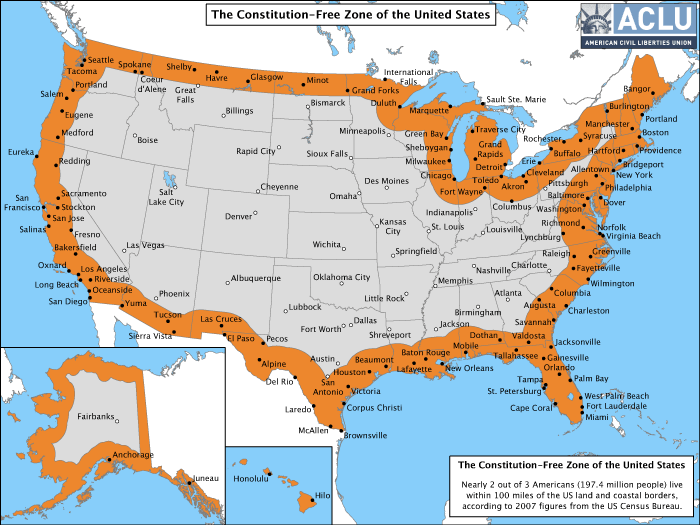
(Click on your state in the map below to find out how many Americans are currently living without full constitutional protection. Check out additional information about Constitution Free Zones here.)
Comments Off on ACLU: Know Your Rights: Constitution Free Zone – Map
WASHINGTON — A Maryland DNA law being challenged in the U.S. Supreme Court helped lead to 43 convictions over the past four years, but state data shows the majority of the convictions could eventually have happened even without the new law.
For years, Maryland required people convicted of serious crimes to provide a DNA sample. The sample, taken from a swab of saliva, was then compared against a database of DNA evidence from crime scenes, and some old cases were able to be solved. Maryland changed its law in 2009, however, so that people had to provide the saliva sample when they were arrested on charges of committing certain violent crimes — before going to trial.
Note: Maryland v. King is being argued Tuesday, Feb. 26 (ScotusBlog). Issue: Whether the Fourth Amendment allows the states to collect and analyze DNA from people arrested and charged with serious crimes.
Comments Off on WaPo: Md. DNA law at center of SCOTUS case aided 43 convictions; many possible even without new law
Bailey v. United States, 2013 U.S. LEXIS 1075 (Feb. 19, 2013) decided by SCOTUS: Detention of a person during execution of a search warrant has to be in the immediate vicinity of the place to be searched, and Bailey wasn’t in the vicinity. If the government can justify it under Terry, they get a shot on remand. Syllabus:
Florida v. Harris, 2013 U.S. LEXIS 1121 (Feb. 19, 2013), decided by SCOTUS. The state proved the drug dog reliable, so its alert is probable cause. Syllabus:
Incorrect time of issuance on the search warrant was a “mere technicality” and a scrivener’s error that could be overlooked by the state proving the correct time. State v. Thompson, 307 Conn. 567, 57 A.3d 323 (2012); State v. Jevarjian, 307 Conn. 559, 58 A.3d 243 (2012) (Also, parking an RV at the house of another did not give one standing to contest the search of the entire house as an overnight guest. It presented a moot question on the RV which still supported the guilty plea.):
Turning first to the defendant’s claim that the trial court improperly relied on parol evidence to determine whether a scrivener’s error was made, we previously have observed that, “although probable cause must be determined from the four corners of the warrant, we are not confined to the four corners of the warrant in determining whether the affidavit in support of probable cause has been validly executed.” State v. Colon, supra, 230 Conn. 34. Mere technical defects are likewise insufficient to invalidate an otherwise valid search warrant. See, e.g., State v. Browne, 291 Conn. 720, 743-44, 970 A.2d 81 (2009). Accordingly, we do not agree with the defendant that the trial court’s reliance on parol evidence to determine the timing of the warrant’s execution was improper.
Comments Off on CT: Error in time on issuance of SW a “mere technicality” that can be overcome by state
The Sixth Circuit sustains a police created exigency, without admitting it, by condoning the police telling the defendant they know he has child pornography on his computer so they could seize it to protect it from destruction. United States v. Bradley, 488 Fed. Appx. 99 (6th Cir. 2012):
An officer confronting students allegedly skipping school to question them about smoking marijuana was not a mere “social contact” and became a detention. State v. Guevara, 172 Wn. App. 184, 288 P.3d 1167 (December 6, 2012).*
The officer was given consent to look in the car. While the officer was looking at the bumper, he could tell the defendant’s stress level went “through the roof.” He noticed that the screws around the inside of the trunk were worn from being removed repeatedly, and plastic push pins were broken. That led to reasonable suspicion to detain for a drug dog. State v. Ochoa, 2012 Tenn. Crim. App. LEXIS 999 (December 7, 2012).*
Because defendant’s backup lights came on when he hit the brakes, the officer was justified in concluding that the brake lights were not in working order, and that justified the stop. State v. Gonzalez, 2012 Tenn. Crim. App. LEXIS 990 (December 5, 2012).*
Comments Off on WA: Confronting students about skipping school to smoke dope was a stop
An unconditional plea is a waiver of one’s denied suppression motion. In the Seventh Circuit, the court notes apparent disagreement in the law but distinguishes the cases, and, if the government objects based on waiver, the court will find waiver. United States v. Adigun, 703 F.3d 1014 (7th Cir. 2012).
Defendant alleged that virtually everything defense counsel did was ineffective assistance, including his failure to object to evidence seized in places other than defendant’s place. “To say that Defendant has utilized the kitchen sink defense in this portion of his motion would be a dramatic understatement. Defendant appears to claim error in every act taken by his counsel and in every aspect in which he allegedly failed to act.” Defendant, however, failed to support anything with a fact claim. No IAC. United States v. Ugochukwu, 2012 U.S. Dist. LEXIS 182708 (N.D. Ohio December 28, 2012).*
Comments Off on CA7: Unconditional plea waives denied suppression motion; no plain error review
The three hour detention of defendant in a building while waiting for a search warrant to arrive where there was no probable cause to believe that the defendant committed any crime or was going to destroy any evidence was unreasonable. His statement during the detention is suppressed. United States v. Watson, 703 F.3d 684 (4th Cir. 2013):
The search warrant for defendant’s pediatric practice was issued with probable cause and was not overbroad authorizing a general search. The doctor was being investigated for inappropriate vaginal exams of girls during routine medical visits. A search warrant was issued for his medical records and for potential videos of the examinations because the police had information that he had video cameras in each examination room and had viewed videos of what he was doing with the girls. Bradley v. State, 51 A.3d 423 (Del. 2012).*
The search of defendant’s car after the stop was with probable cause, so Gant does not apply. United States v. Sicking, 2012 U.S. Dist. LEXIS 126641 (E.D. Tex. August 8, 2012).*
The stop and detention of the vehicle was with reasonable suspicion. The defendant lacked standing to challenge its search. United States v. Lee, 2012 U.S. Dist. LEXIS 126783 (E.D. N.C. July 30, 2012),* adopted 2012 U.S. Dist. LEXIS 127613 (E.D. N.C. September 6, 2012).*
The officer’s parking in front of defendant’s car blocking him was not a seizure, but, even if it was, it was with reasonble suspicion. United States v. Anthony, 487 Fed. Appx. 921 (5th Cir. 2012).*
Comments Off on DE: SW for doctor’s files and videos of young female patients he was alleged to have assaulted was issued with PC and was not general
The juvenile was with three others three minutes before curfew walking in the middle of the street. The officer told them to come over toward the police car so he could tell them to walk on the sidewalk, and he was also curious about where they lived since curfew was in minutes. The juvenile tugged at his pants like a gun was weighing them down, in the officer’s experience. That justified a patdown for the weapon that was found. State in the Interest of T.H., 2012 La. App. LEXIS 1645 (La.App. 4 Cir. December 12, 2012).
“Here, the officers did no more than they were authorized to do by Terry. The approach of the defendant, on a public street, by officers who wore no uniforms and therefore identified themselves by displaying their badges, and who neither displayed any weapons nor engaged in hostile or aggressive actions towards the defendant, did not impinge upon any constitutionally protected interest of the defendant.” Commonwealth v. Damelio, 83 Mass. App. Ct. 32 (December 14, 2012).*
Defendant was stopped for a traffic offense, and the officer asked for his DL and papers. Sitting on the seat next to the driver was a crumpled brown paper bag. The officer asked for the bag, and in it was cocaine. The turning over the bag was by consent, not a response to a command. State v. Milton, 104 So. 3d 414 (La. 2012).*
Comments Off on LA4: Tugging at one’s pants belies a gun and can justify a frisk
Defendant was stopped for alleged violation of a protective order. He objected that there was no showing of probable cause by the state for the underlying order, and he’s right. The state’s failure to prove probable cause for the protective order was fatal to the arrest. No witness with knowledge of it testified at the suppression hearing. People v. Hyland, 2012 IL App (1st) 110966, 981 N.E.2d 414 (2012):
The address on the search warrant was wrong, but the right one was searched. [Not the question.] The officer getting the search warrant knew the correct place to be searched because he’d been there before, and it was unlikely the wrong place would be searched. In addition, that it was the right place was confirmed by an occupant who told the officer where to find what they were looking for. Ritter v. State, 2011 Ark. 427, 385 S.W.3d 740 (2011)*:
In the present case, the warrant contained an incorrect address, thus increasing the likelihood of searching the wrong residence. But this likelihood was mitigated by the fact that the officers executing the warrant personally knew which premises were to be searched and the fact that the intended location was under surveillance while Lt. Vanravensway secured the warrant. In addition, the affidavit included facts indicating that it was the Ritter residence, not the Rideout residence, that was intended to be searched. After listing numerous facts about Ritter and referring to the Ritter residence, Lt. Vanravensway noted that Special Agent Mendenhal had learned from Ms. Ritter that Ritter had left their residence with a gun and returned approximately thirty minutes later, still carrying the gun. The affidavit also stated that Ms. Ritter told Special Agent Mendenhal that she had placed the gun under a mattress in the Ritter residence. Moreover, Chief Deputy Staggs testified that, while waiting to begin the search, he walked past Ms. Ritter and asked her how she was doing, and Ms. Ritter told him, “The gun you’re looking for is under the mattress. There’s [a] pillow case with some shotgun shells under there as well.” Ms. Ritter’s statement, made shortly before the warrant was executed at the Ritter residence, further mitigated the likelihood that the officers were at the wrong residence. Finally, the premises that were intended to be searched were, in fact, searched. We hold that the circuit court did not err in denying Ritter’s motion to suppress.
The record supports the trial court’s conclusion that defendant consented to search of his person. Webb v. State, 2011 Ark. 430, 385 S.W.3d 152 (2011).*
Comments Off on AR: While wrong address was on SW, chance of searching wrong place was slight
"If it was easy, everybody would be doing it. It isn't, and they don't." —Me
"Life is not a matter of holding good cards, but of playing a poor hand well." –Josh Billings (pseudonym of Henry Wheeler Shaw), Josh Billings on Ice, and Other Things (1868) (erroneously attributed to Robert Louis Stevenson, among others)
“I am still learning.” —Domenico Giuntalodi (but misattributed to Michelangelo Buonarroti (common phrase throughout 1500's)).
"Love work; hate mastery over others; and avoid intimacy with the government."
—Shemaya, in the Thalmud
"It is a pleasant world we live in, sir, a very pleasant world. There are bad people in it, Mr. Richard, but if there were no bad people, there would be no good lawyers."
—Charles Dickens, “The Old Curiosity Shop ... With a Frontispiece. From a Painting by Geo. Cattermole, Etc.” 255 (1848)
"A system of law that not only makes certain conduct criminal, but also lays down rules for the conduct of the authorities, often becomes complex in its application to individual cases, and will from time to time produce imperfect results, especially if one's attention is confined to the particular case at bar. Some criminals do go free because of the necessity of keeping government and its servants in their place. That is one of the costs of having and enforcing a Bill of Rights. This country is built on the assumption that the cost is worth paying, and that in the long run we are all both freer and safer if the Constitution is strictly enforced." —Williams v. Nix, 700 F. 2d 1164, 1173 (8th Cir. 1983) (Richard Sheppard Arnold, J.), rev'd Nix v. Williams, 467 US. 431 (1984).
"The criminal goes free, if he must, but it is the law that sets him free. Nothing can destroy a government more quickly than its failure to observe its own laws, or worse, its disregard of the charter of its own existence." —Mapp v. Ohio, 367 U.S. 643, 659 (1961).
"Any costs the exclusionary rule are costs imposed directly by the Fourth Amendment."
—Yale Kamisar, 86 Mich.L.Rev. 1, 36 n. 151 (1987).
"There have been powerful hydraulic pressures throughout our history that bear heavily on the Court to water down constitutional guarantees and give the police the upper hand. That hydraulic pressure has probably never been greater than it is today." — Terry v. Ohio, 392 U.S. 1, 39 (1968) (Douglas, J., dissenting).
"The great end, for which men entered into society, was to secure their property." —Entick v. Carrington, 19 How.St.Tr. 1029, 1066, 95 Eng. Rep. 807 (C.P. 1765)
"It is a fair summary of history to say that the safeguards of liberty have frequently been forged in controversies involving not very nice people. And so, while we are concerned here with a shabby defrauder, we must deal with his case in the context of what are really the great themes expressed by the Fourth Amendment." —United States v. Rabinowitz, 339 U.S. 56, 69 (1950) (Frankfurter, J., dissenting)
"The course of true law pertaining to searches and seizures, as enunciated here, has not–to put it mildly–run smooth." —Chapman v. United States, 365 U.S. 610, 618 (1961) (Frankfurter, J., concurring).
"A search is a search, even if it happens to disclose nothing but the bottom of a turntable." —Arizona v. Hicks, 480 U.S. 321, 325 (1987)
"For the Fourth Amendment protects people, not places. What a person knowingly exposes to the public, even in his own home or office, is not a subject of Fourth Amendment protection. ... But what he seeks to preserve as private, even in an area accessible to the public, may be constitutionally protected." —Katz v. United States, 389 U.S. 347, 351 (1967)
“Experience should teach us to be most on guard to protect liberty when the Government’s purposes are beneficent. Men born to freedom are naturally alert to repel invasion of their liberty by evil-minded rulers. The greatest dangers to liberty lurk in insidious encroachment by men of zeal, well-meaning but without understanding.” —United States v. Olmstead, 277 U.S. 438, 479 (1925) (Brandeis, J., dissenting)
“Liberty—the freedom from unwarranted intrusion by government—is as easily lost through insistent nibbles by government officials who seek to do their jobs too well as by those whose purpose it is to oppress; the piranha can be as deadly as the shark.” —United States v. $124,570, 873 F.2d 1240, 1246 (9th Cir. 1989)
"You can't always get what you want / But if you try sometimes / You just might find / You get what you need." —Mick Jagger & Keith Richards, Let it Bleed (album, 1969)
"In Germany, they first came for the communists, and I didn't speak up because I wasn't a communist. Then they came for the Jews, and I didn't speak up because I wasn't a Jew. Then they came for the trade unionists, and I didn't speak up because I wasn't a trade unionist. Then they came for the Catholics and I didn't speak up because I wasn't a Catholic. Then they came for me–and by that time there was nobody left to speak up."
—Martin Niemöller (1945) [he served seven years in a concentration camp]
“Children grow up thinking the adult world is ordered, rational, fit for purpose. It’s crap. Becoming a man is realising that it’s all rotten. Realising how to celebrate that rottenness, that’s freedom.” – John le Carré, The Night Manager (1993), line by Richard Roper
"The point of the Fourth Amendment, which often is not grasped by zealous officers, is not that it denies law enforcement the support of the usual inferences which reasonable men draw from evidence. Its protection consists in requiring that those inferences be drawn by a neutral and detached magistrate instead of being judged by the officer engaged in the often competitive enterprise of ferreting out crime." —Johnson v. United States, 333 U.S. 10, 13-14 (1948)
The book was dedicated in the first (1982) and sixth (2025) editions to Justin William Hall (1975-2025). He was three when this project started in 1978.